
Table of Contents
Persistent lower back pain, stiffness, leg pain, numbness or difficulty walking should not always be dismissed as a normal part of ageing. One possible cause is lumbar spondylosis, a degenerative condition affecting the bones, discs and joints of the lower spine.
Some people have mild stiffness, while others develop sciatica, nerve compression, weakness or reduced mobility. The right lumbar spondylosis treatment in Solapur depends on symptoms, neurological findings and imaging. Surgery is not automatically required because degeneration appears on an X-ray or MRI.
What Is Lumbar Spondylosis?
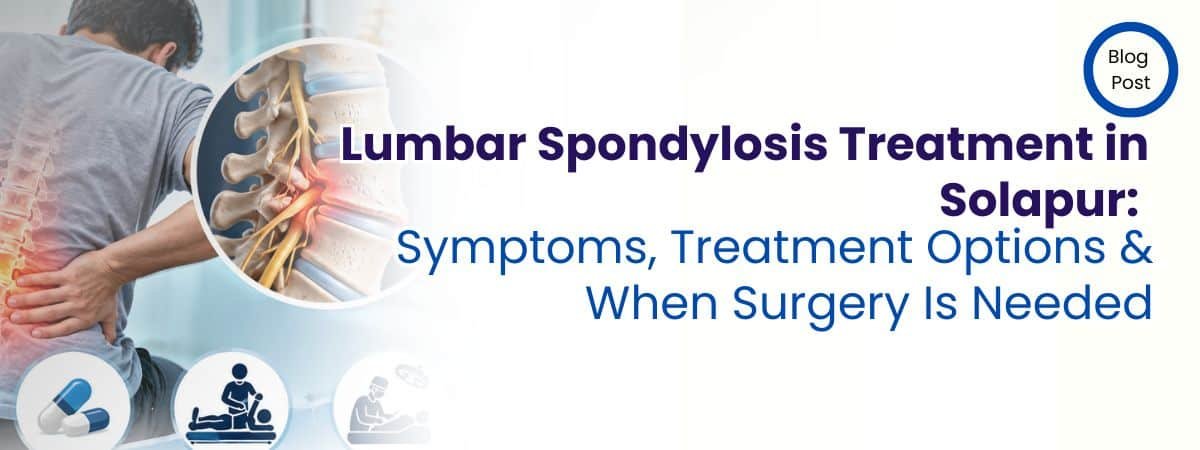
Lumbar spondylosis refers to age-related and degenerative changes in the lower spine. Discs may lose height, facet joints may degenerate, bone spurs may develop and spaces around nerves may narrow, sometimes contributing to nerve compression or spinal stenosis.
MRI findings do not always cause symptoms and must be considered with the patient’s symptoms and examination.
What Causes Lumbar Spondylosis?
Common factors include increasing age, repeated stress on the lower back, previous spinal injury, physically demanding work, poor posture, excess body weight, reduced physical activity, degenerative disc changes and spinal arthritis. Although age is important, younger people with previous injuries or other risk factors may also develop degeneration.
Lumbar Spondylosis Symptoms
Symptoms vary from person to person. Some people have degenerative changes without significant discomfort, while others develop pain or nerve-related symptoms.
Lower Back Pain and Stiffness
Pain may be dull or aching, intermittent or persistent, and may worsen after prolonged standing, certain movements or inactivity. Stiffness may be noticeable after waking or prolonged sitting.
Persistent discomfort may require evaluation. Learn more about low back pain treatment in Solapur.
Leg Pain or Sciatica
When a nerve root is irritated or compressed, pain may travel from the lower back or buttock into the thigh, calf or foot. This may be described as sciatica, although leg pain has several possible causes. More information is available about sciatica treatment in Solapur.
Tingling, Numbness and Weakness
Nerve irritation may cause tingling, burning, numbness or altered sensation in the leg or foot. Significant involvement may also cause weakness, such as difficulty lifting the foot or walking.
Persistent symptoms can be explored through tingling and numbness treatment in Solapur. Progressive weakness requires prompt medical assessment.
Difficulty Standing or Walking
Degenerative narrowing may cause leg pain, heaviness, numbness, weakness or cramping after standing or walking, sometimes improving after sitting. Chronic pain can also reduce activity and strength.
Lumbar Spondylosis vs Slip Disc
Lumbar spondylosis describes degenerative changes in the spine, while a slip disc or herniated disc involves disc material moving beyond its normal boundaries and possibly irritating a nerve. Both can occur together.
Read more about slip disc treatment in Solapur.
Lumbar Spondylosis and Sciatica
Lumbar spondylosis can contribute to nerve-root narrowing and radiating leg pain, but not every case of sciatica is caused by it. See sciatica treatment in Solapur for additional information.
How Is Lumbar Spondylosis Diagnosed?
Diagnosis begins with medical history and physical and neurological examination. A specialist may assess pain duration, progression, leg symptoms, numbness, weakness, walking limitations and previous treatment. The examination may include strength, reflexes, sensation and walking pattern.
Imaging Tests
X-Ray: Can show alignment, degenerative changes, disc-space changes and bone spurs.
MRI: Provides detailed information about discs, nerves, spinal canal narrowing and nerve compression.
CT: Provides detailed information about bony structures and may be useful in selected cases.
Imaging is not required for every episode of back pain, and an MRI report should not be interpreted in isolation.
Lumbar Spondylosis Treatment in Solapur
Treatment depends on the severity and cause. Many patients can initially be managed without surgery.
1. Activity Modification
During painful flare-ups, activities may need to be modified temporarily. Complete prolonged bed rest is not generally the goal; appropriate movement may help maintain mobility when it does not worsen neurological symptoms.
2. Medicines
A doctor may prescribe medicines for pain, inflammation, muscle spasm or nerve-related pain. Medication should consider age, medical conditions, other medicines and side effects. Avoid regular self-medication.
3. Physiotherapy
Physiotherapy may focus on core strength, flexibility, posture, safe movement and mobility. Exercises should be individualized.
4. Weight and Lifestyle Management
Gradual weight management may reduce mechanical stress. Long-term care may include low-impact activity, good posture, safe lifting and regular movement breaks.
5. Treatment for Nerve Compression
When degeneration causes nerve irritation or compression, treatment should address the specific source. Patients with persistent symptoms can also read about tingling and numbness treatment in Solapur.
When Does Lumbar Spondylosis Need Surgery?
Lumbar spondylosis does not automatically mean surgery is required. Surgical evaluation may be considered when symptoms remain significant despite appropriate non-surgical treatment or when important neurological problems develop.
Possible reasons include:
- Persistent disabling symptoms despite conservative treatment
- Severe leg pain caused by nerve compression
- Progressive muscle weakness
- Significant difficulty walking or standing
- Persistent or progressive numbness with neurological deficits
- Severe spinal stenosis causing disabling symptoms
- Certain serious neurological emergencies
New loss of bladder or bowel control, numbness around the groin or rapidly worsening leg weakness requires urgent medical assessment.
What Is Lumbar Spondylosis Surgery in Solapur?
The procedure depends on the exact problem. Surgery may involve decompression, laminotomy, laminectomy, foraminotomy, discectomy or spinal fusion. Not every patient needs fusion.
The choice depends on nerve compression, stenosis, disc condition, alignment, instability, spondylolisthesis, affected levels and neurological findings. Treatment should not be selected from an MRI report alone.
Minimally Invasive and Endoscopic Spine Surgery
Selected patients may be candidates for minimally invasive techniques, which aim to treat affected structures while limiting unnecessary tissue disruption. They are not automatically better for everyone; the technique should match the spinal problem. Learn more about minimally invasive spine surgery in Solapur and endoscopic spine surgery in Solapur.
Lumbar Spondylosis With Spondylolisthesis
Degenerative changes may occur with spondylolisthesis, where one vertebra shifts relative to another and may contribute to back pain or nerve symptoms. Treatment depends on slippage, symptoms, stability and neurological findings. Read more about spondylolisthesis treatment in Solapur.
Is Every Patient a Candidate for Surgery?
No. Significant MRI degeneration may still be managed without surgery when symptoms are manageable and there is no neurological deficit. Conversely, significant neurological symptoms can require attention even when imaging looks less dramatic.
The decision should consider:
Symptoms + Neurological Examination + Imaging Findings
When Should You See a Neurosurgeon?
Consider specialist evaluation when back pain persists, worsens, travels into the leg, causes numbness or weakness, affects walking or daily activities, or does not improve with conservative care.
Evaluation is also important after significant trauma or other concerning symptoms. See low back pain treatment in Solapur for more information.
Red-Flag Symptoms
Seek urgent medical attention for:
- New loss of bladder or bowel control
- Numbness around the groin or inner thighs
- Rapidly worsening weakness
- Severe difficulty walking
- Major trauma
- Severe pain with concerning neurological symptoms
These may indicate significant nerve compression or another serious spinal condition. After a significant injury, neuro trauma treatment in Solapur may also be relevant.
Can Lumbar Spondylosis Be Prevented?
Age-related degeneration cannot always be prevented, but healthy habits can support spinal function:
- Stay physically active and maintain a healthy weight
- Improve posture and use safe lifting techniques
- Take regular breaks from sitting
- Do not ignore weakness, numbness or other neurological symptoms
Early evaluation can help identify nerve involvement.
Why Choosing the Right Spine Specialist Matters
Back pain may result from lumbar spondylosis, slip disc, sciatica, spinal stenosis, spondylolisthesis, nerve compression, trauma or other conditions. Specialist evaluation can help determine whether conservative treatment, further testing or surgery is appropriate.
For lumbar spondylosis treatment in Solapur, Dr. Ranjeet Kadam provides neurosurgical evaluation and treatment at Yashodhara Super Speciality Hospital, Unit 2, Solapur–Hyderabad Road, near Market Yard, Solapur.
Consult Dr. Ranjeet Kadam for Lumbar Spondylosis in Solapur
Persistent lower-back pain, leg pain, numbness or weakness should not be ignored, especially when symptoms affect walking, work or everyday activities.
Dr. Ranjeet Kadam, Consultant Neurosurgeon, MBBS, MS, M.Ch. (Neurosurgery), provides evaluation and treatment for brain and spine conditions at:
Yashodhara Super Speciality Hospital, Unit 2
Solapur–Hyderabad Road, Near Market Yard, Solapur
If you are looking for lumbar spondylosis treatment in Solapur, specialist evaluation can help identify the cause of symptoms and determine whether conservative treatment or further intervention may be appropriate.
Call: 7666270037
Book an Appointment with Dr. Ranjeet Kadam to discuss back pain, leg symptoms, numbness, weakness or other spine-related concerns.
Medical Disclaimer
This article is for general educational purposes and is not a substitute for individual medical consultation, diagnosis or treatment. Back pain and neurological symptoms can have multiple causes. If you have severe or rapidly worsening symptoms, new weakness, loss of bladder or bowel control, or numbness around the groin, seek urgent medical attention.
Conclusion
Lumbar spondylosis is common, but its effect varies. Some people have stiffness, while others develop back pain, sciatica, numbness, weakness or difficulty walking because of nerve compression.
The right lumbar spondylosis treatment in Solapur depends on the patient. Medicines, physiotherapy, activity modification and lifestyle measures can often help, while disabling symptoms, progressive weakness or significant nerve compression may require surgical evaluation.
Getting the right diagnosis is the first step toward choosing the right treatment.
For specialist evaluation of lumbar spondylosis and other spine conditions in Solapur, consult Dr. Ranjeet Kadam, Consultant Neurosurgeon, at Yashodhara Super Speciality Hospital, Unit 2.
FAQs
1. What is the best treatment for lumbar spondylosis?
There is no single best treatment. Depending on the patient, treatment may include activity modification, medicines, physiotherapy, lifestyle measures and, in selected cases, surgery.
2. What are common lumbar spondylosis symptoms?
Common symptoms include lower back pain, stiffness and reduced mobility. Nerve involvement may cause leg pain, tingling, numbness or weakness.
3. Does lumbar spondylosis always require surgery?
No. Many patients can be managed without surgery; it may be considered for persistent disabling symptoms or significant neurological problems.
4. When is surgery needed?
Surgery may be considered for disabling nerve compression, progressive weakness, difficulty walking or persistent symptoms despite appropriate conservative treatment.
5. Can lumbar spondylosis cause sciatica?
Yes. Degenerative changes can narrow the space around a nerve root and produce radiating leg pain, although sciatica has several causes.
6. Can physiotherapy help?
Physiotherapy may improve strength, flexibility, mobility and function when tailored to the patient.
7. Is MRI necessary for every patient with back pain?
No. A doctor decides whether imaging is appropriate based on symptoms, examination findings, duration and warning signs.
8. What is the difference between lumbar spondylosis and a slip disc?
Lumbar spondylosis describes degeneration, while a slip disc involves displacement or herniation of disc material. Both may cause nerve compression.
